



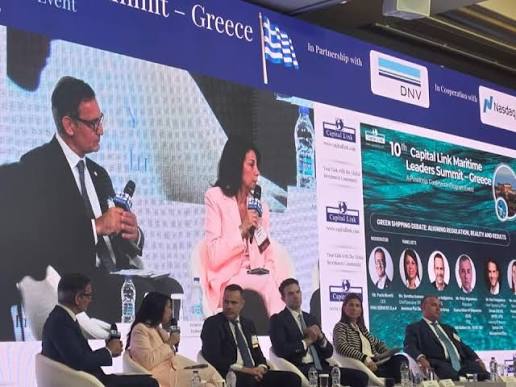
Green Shipping Takes Centre Stage at Capital Link Maritime Leaders Summit
Athens: The future of green shipping, regulatory alignment and the practical challenges of maritime decarbonisation dominated discussions at the 10th Capital Link Maritime Leaders Summit, held during Posidonia Week in Greece on June 1, 2026. The biennial event, organised by Capital Link in partnership with DNV and in cooperation with Nasdaq and the New York Stock Exchange (NYSE), brought together senior executives, shipowners, regulators and industry stakeholders to examine the changing landscape of global shipping.

One of the most anticipated sessions of the summit was the panel discussion titled “Green Shipping Debate: Aligning Regulation, Reality and Results,” where some of the industry’s most influential leaders exchanged views on the opportunities and challenges surrounding the transition to a low-carbon maritime sector.
The panel featured Dorothea Ioannou, Chief Executive Officer of the American P&I Club; Andreas Hadjipetrou, Chief Executive Officer of Columbia Shipmanagement; Polys Hajioannou, President of the Cyprus Union of Shipowners and CEO of Safe Bulkers Inc.; Alex Hadjipateras, Chief Operating Officer of Dorian LPG Ltd. and Managing Director of Dorian LPG Management Corp.; and Ioanna Procopiou, Managing Director of PROMINENCE MARITIME SA and President Designate of BIMCO. The discussion was moderated by Paolo Moretti, Chief Executive Officer of RINA SERVICES S.p.A.
The session focused on one of the most pressing issues facing global shipping today—how to achieve meaningful decarbonisation while ensuring that regulations remain practical, commercially viable and globally consistent. Panelists agreed that the industry’s transition towards cleaner operations requires not only ambitious environmental targets but also realistic implementation strategies supported by technological innovation and adequate investment.
Speakers highlighted that shipping companies are operating in an increasingly complex regulatory environment, with international and regional rules evolving rapidly. They stressed the importance of harmonising regulations to avoid fragmented compliance requirements that could increase costs and create uncertainty for shipowners and operators.
The debate also underscored the need for close collaboration among governments, regulators, classification societies, financial institutions and the shipping industry. Participants noted that achieving the International Maritime Organization’s greenhouse gas reduction objectives will require coordinated action across the entire maritime value chain.
Another key topic was the availability of alternative marine fuels and the infrastructure needed to support them. Panelists observed that while fuels such as methanol, ammonia, liquefied natural gas and hydrogen are expected to play important roles in the energy transition, widespread adoption will depend on fuel availability, safety standards, port infrastructure and commercial competitiveness.
Industry leaders also pointed to the significant financial implications of decarbonisation. Fleet renewal, retrofitting existing vessels and investing in new propulsion technologies require substantial capital, making access to financing and supportive policy frameworks critical for accelerating the transition.
The discussion further explored the balance between environmental responsibility and maintaining the competitiveness of global shipping. Participants argued that regulations should encourage innovation without placing disproportionate burdens on shipowners, particularly during a period when technologies and fuel markets are still evolving.
Digitalisation, operational efficiency and data-driven decision-making were also identified as essential tools for reducing emissions in the near term. Improved voyage planning, energy-efficient vessel operations and enhanced monitoring systems can deliver immediate environmental benefits while the industry prepares for longer-term technological solutions.
The Capital Link Maritime Leaders Summit has established itself as one of the flagship events during Posidonia Week, providing a platform for dialogue among leading shipping executives, investors and policymakers. This year’s discussions reflected the growing urgency of balancing environmental commitments with commercial realities as the maritime sector navigates one of the most significant transformations in its history.
The green shipping debate concluded with a clear message: successful maritime decarbonisation will depend on aligning regulation with operational realities, encouraging innovation, ensuring access to sustainable fuels and maintaining close cooperation across the global shipping industry. As environmental expectations continue to rise, industry leaders agreed that practical, globally coordinated solutions will be essential to delivering measurable progress toward a cleaner and more sustainable future for international shipping.

Author: shipping inbox
shipping and maritime related web portal