



Freight Markets Face Diverging Tides: Capesizes Power Dry Bulk Rebound While Geopolitical Strain Roils Global Tankers
SINGAPORE — Global freight and maritime trade entered late October navigating a sharply divided landscape, as heavy-cargo dry bulk carriers engineered a late-week rally while the international tanker sector grappled with historic logistics costs, geopolitical flashpoints, and expanding regulatory sanctions, according to the latest market report issued by shipbroker Star Asia.

The dry bulk arena showed notable resilience during the week ending October 23, with the composite Baltic Dry Index (BDI) climbing 5.93% week-on-week to settle at 2,660 points—marking a steep 33.6% gain compared to the same period last year. The surge was driven almost entirely by the Capesize segment, where the Baltic Capesize Index (BCI) jumped 16.68% to 3,791 points. Robust paper market gains late in the week triggered a rebound across Pacific and South Atlantic routes, pushing spot returns on East Coast South America runs to over US$67,420 per day. Panamax tonnage, by contrast, remained under pressure, shedding 8.86% to 2,109 points as sluggish grain demand from the U.S. Gulf and accumulating Atlantic tonnage weighed on long-haul earnings.
Alang and South Asian Ship Recycling Anchor Amid Scarcity
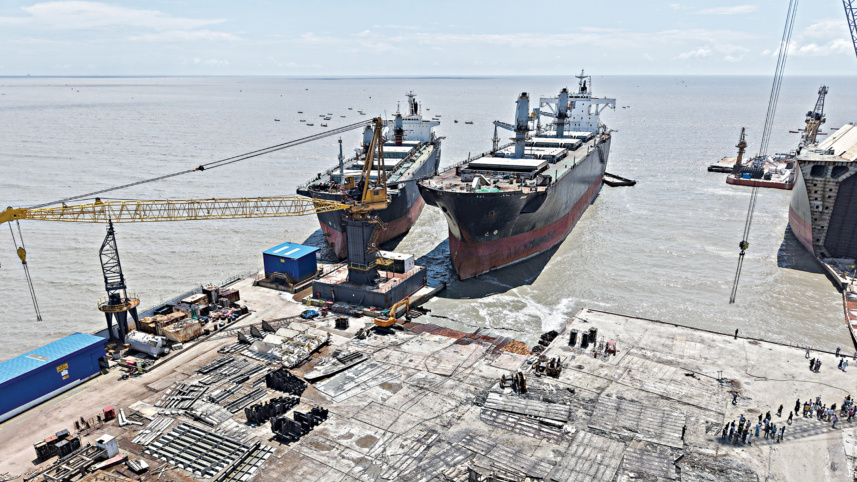
On the ship recycling waterfront, yards across the Indian Subcontinent reported steady price sentiment, though beaching activity remained restrained by holiday observances and a dry international candidate pool.
At Alang, India’s primary demolition hub, beaching operations slowed down amid regional festival closures. Scrap price indications remained well-supported at US$490–500 per light displacement tonnage (LDT) for tankers and US$480–490/LDT for bulk carriers. Domestic re-rollable steel demand provided firm support, even as end-buyers found workable tonnage difficult to secure due to elevated secondary trading prices.
Recycling facilities in Chattogram, Bangladesh, held quotes at US$510–520/LDT for tankers, though mills largely avoided speculative bidding amid tight local liquidity. Across the border in Gaddani, Pakistan, where quotes mirrored Chattogram levels, recyclers welcomed the government’s suspension of commercial truck transit along the Iranian border at Taftan and Gabd-Rimdan. Recyclers anticipate the shutdown will curb inflows of cheap smuggled billet, though local industrial chambers expressed concern that cross-border friction could inflate domestic LPG and energy overheads for re-rolling operations in the weeks ahead.
Tankers Confront Soaring Risks and Port Frictions
While bulkers capitalized on rebounding mineral demand, the wet trade encountered extreme logistical headwinds. Although the Baltic Dirty Tanker Index (BDTI) softened 7.44% on the week to 7,152 points as charterers drip-fed cargoes following an earlier fixture frenzy, underlying operational expenses have ballooned to extraordinary levels.
Persistent regional security flare-ups and drone strikes around the Persian Gulf and the Strait of Hormuz have sent war-risk insurance premiums surging to roughly 8% of vessel value—adding US$9 million to US$10 million per voyage. Protracted delays in ship-to-ship (STS) transfer zones off Oman have pushed daily demurrage rates near US$1 million, penalizing laden Very Large Crude Carriers (VLCCs) by approximately US$0.50 per barrel for every day spent idle.
Compounding commercial frictions, Western regulatory pressure tightened under the U.S. Treasury’s latest enforcement sweep, dubbed Operation Economic Outcast. The action designated nine additional vessels alongside maritime facilitators—including Dubai-based Whales Shipping Line, Singapore-registered Amigoz, fleet manager Roxette Maritime Shipping, and legal practice Karnakis & Karnakis—for circumventing trade caps on Russian and Middle Eastern commodity flows.
Russian Crude Flows Hit Upstream Constraints
In the crude export arena, Russian seaborne loadings touched multi-week lows following maintenance-related berth closures at the key Baltic port of Primorsk, dragging down national revenues despite stable dispatch volumes out of Novorossiysk on the Black Sea.
Industry analysts point out that Moscow’s supply issues extend deeper than temporary terminal bottlenecks or recent Ukrainian drone strikes against domestic processing units in Ryazan and western Siberia. Russia’s nationwide crude production fell to roughly 8.5 million barrels per day in September—its lowest monthly volume in more than six years and the tenth consecutive month of domestic decline. This tightening upstream ceiling is constraining Russia’s physical capacity to expand seaborne volumes, even as major Asian refiners continue to clear available Pacific grades like ESPO.
Container Carriers Defend Margins as Reroutings Shift
Container freight rates traded in a narrow corridor, with the Shanghai Containerized Freight Index (SCFI) edging up to 3,681.34 points. Mainline operators have begun defending baseline rates ahead of 2027 contract renewals, with Mediterranean Shipping Company (MSC) rolling out updated Freight All Kinds (FAK) tariffs.
However, BIMCO cautioned that the industry faces longer-term supply headwinds. As container services progressively resume transit through the Suez Canal, the reduction in voyage distances will unwind the capacity absorption created by Cape of Good Hope diversions, threatening a market where fleet supply growth significantly outpaces trade demand.
In regional Middle East logistics, Iraq’s state maritime carrier inaugurated an eight-day feeder shuttle between Jebel Ali and Umm Qasr deploying the 902 TEU vessel Basrah—its first scheduled Gulf loop since the mid-1960s—to help bypass persistent overland chokepoints.

Author: shipping inbox
shipping and maritime related web portal