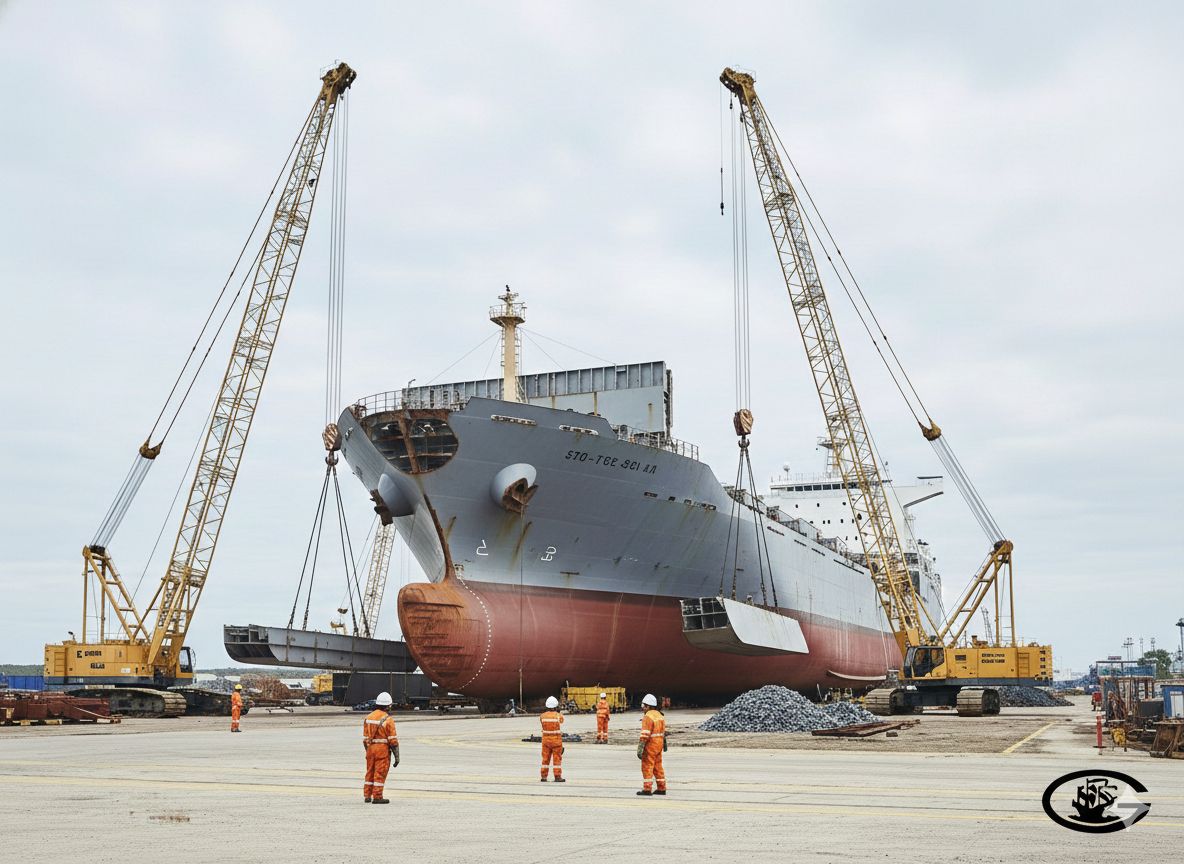





Ship Recycling Debate Shifts Focus to Circular Economy and Steel Decarbonisation
The global debate on ship recycling and circular economy practices has gained renewed momentum after the NGO Shipbreaking Platform acknowledged the role of ship recycling in supporting steel decarbonisation and secondary raw material supply under the proposed European Union Circular Economy Act.

Industry experts say the recognition marks a significant shift in how end-of-life ships are viewed — not as waste, but as valuable repositories of reusable steel and industrial materials capable of contributing to a low-carbon economy.
Responding to the NGO’s latest position, maritime sustainability advocates argued that the conversation surrounding ship recycling must move beyond regional comparisons and focus instead on the complete lifecycle of materials recovered from ships.
“Ships at end of life are not waste. They are one of the world’s most valuable circular material banks,” said Dr. Anand Hiremath in a detailed commentary on the issue. He welcomed the NGO’s acknowledgement that ship recycling can play an important role in circularity, steel reuse and decarbonisation efforts.
According to industry estimates, a single large ocean-going vessel contains thousands of tonnes of recyclable steel, machinery, copper, aluminium and other reusable materials. Properly recycled ships can therefore significantly reduce the demand for virgin steel production, one of the world’s most carbon-intensive industries.
The latest discussion comes at a time when governments and industries worldwide are accelerating efforts to cut greenhouse gas emissions and adopt circular economy models that minimise waste and maximise resource recovery.
Experts noted that South Asia — particularly India, Bangladesh and Pakistan — has been at the centre of global ship recycling operations for decades. The region accounts for the majority of the world’s end-of-life vessel recycling capacity due to its extensive re-rolling mills, steel demand and labour-intensive dismantling ecosystem.
Supporters of the South Asian recycling industry argue that the region already embodies circular economy principles on a large scale. Recovered steel plates from dismantled ships are routinely reused in construction, infrastructure, fabrication and rerolling industries, creating a direct industrial loop with minimal transport and processing requirements.
“The region has the recycling capacity, steel demand, re-rolling ecosystem and industrial need to return recovered ship steel directly into productive use,” the commentary noted.
Industry observers also emphasised that the central issue should not be framed as “Europe versus South Asia,” but rather whether ship recycling takes place in facilities that are safe, environmentally responsible and internationally certified.
This argument has gained importance following the implementation of stricter global regulations, including the Hong Kong International Convention for the Safe and Environmentally Sound Recycling of Ships, which is aimed at improving worker safety and environmental standards in the industry.
In recent years, several ship recycling yards in India, especially at Alang in Gujarat, have upgraded infrastructure and compliance systems to meet international standards. Multiple yards have obtained Statements of Compliance with the Hong Kong Convention and approvals from major classification societies.
Industry stakeholders believe these developments demonstrate that responsible recycling can coexist with high levels of material recovery and industrial reuse.
Environmental economists also point out that transporting recyclable steel over long distances for processing can itself generate additional carbon emissions. As a result, regions where dismantling, rerolling and steel reuse occur within integrated industrial clusters may offer stronger environmental benefits than previously assumed.
The discussion around ship recycling is expected to intensify further as the European Union advances its Circular Economy Act and global shipping transitions toward greener operations.
Analysts say the debate is increasingly moving away from simplistic narratives and toward measurable environmental outcomes, including lifecycle carbon emissions, material recovery efficiency and industrial reuse value.
“Now let us follow the carbon, the steel and the facts,” Dr. Hiremath remarked, calling for evidence-based discussions on the future of sustainable ship recycling.
With global steel demand continuing to rise and decarbonisation pressures mounting, ship recycling is emerging not merely as a waste-management activity, but as a strategic component of the world’s circular industrial economy.

Author: shipping inbox
shipping and maritime related web portal