




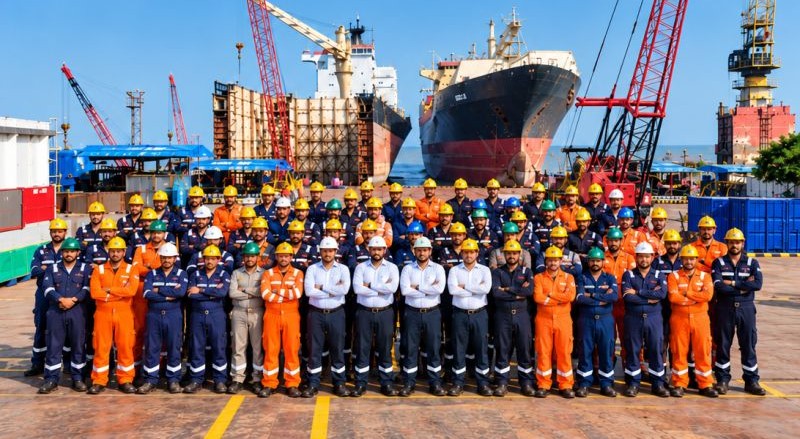
CIRCULAR HORIZONS: HOW RESPONSIBLE SHIP RECYCLING IS RESHAPING MARITIME SUSTAINABILITY
BHAVNAGAR — As the global shipping industry charts a course toward decarbonization and stricter environmental stewardship, the conversation around the lifecycle of ocean-going vessels has reached a pivotal juncture. Nowhere is this transformation more evident than along the tidal yards where end-of-life vessels undergo dismantling—a sector steadily evolving from heavy scrap demolition into a high-precision, green circular industry.

Long regarded as a gritty industrial necessity, modern ship recycling is increasingly recognized as a cornerstone of sustainable resource recovery. Large commercial vessels yield tens of thousands of tons of high-grade steel, re-rollable scrap, machinery, and non-ferrous metals, providing raw materials that carry a significantly lower carbon footprint than virgin mined ores.
However, industry leaders emphasize that resource recovery can no longer come at the cost of workforce safety or ecological integrity.
“Ship recycling has always been about more than dismantling vessels,” states the leadership of Leela Group, a prominent player in the green recycling domain. “It is about recovering valuable resources, protecting the people who do the work, and respecting the environment in which we operate.”
The shift marks a deliberate cultural change within an industry historically governed by the pursuit of low-cost salvage. With the enforcement of global environmental protocols such as the Hong Kong International Convention for the Safe and Environmentally Sound Recycling of Ships, yards across major maritime hubs have poured capital into impermeable drainage floors, hazardous material abatement infrastructure, heavy-lift cranes, and comprehensive health monitoring for labor forces.
Yet, as market demands evolve, compliance alone is ceasing to be the defining benchmark of operational excellence.
“At Leela Group, we have always believed that responsibility must come before recognition, and that doing things right matters more than simply meeting requirements,” company officials noted. “A vessel that has served the world’s trade deserves a proper send-off. International standards and certifications are important milestones, but they are not the destination. The true measure of our commitment lies in the decisions we make and the practices we follow on our yards every single day.”
This philosophy arrives at a critical moment. Major shipowners, institutional financiers, and ESG-conscious cargo clients now scrutinize downstream operations with unprecedented rigor. Vessels entering their decommissioning phase are no longer quietly transferred through opaque broker chains; instead, charterers and owners seek transparent, audit-ready facilities that offer full cradle-to-grave accountability.
The urgency is twofold. With thousands of vessels projected to retire over the coming decade to make way for alternative-fuel fleets, yard capacity built on clean methodologies must scale up to prevent bottlenecks.
“As the maritime industry moves towards a more sustainable and circular future, ship recycling has an increasingly important role to play. With that opportunity comes an even greater responsibility,” Leela Group affirmed. “Our journey has been one of continuous learning, investment, and improvement, guided by a simple belief: standards are not just there to be met, but to be raised. That is the commitment we have built upon, and one we intend to carry forward.”
As regulatory pressure tightens across global shipping routes, the facilities willing to push past minimum benchmarks are setting the pace—proving that the final chapter of a ship’s voyage can be defined by environmental dignity and long-term industrial value.

Author: shipping inbox
shipping and maritime related web portal