



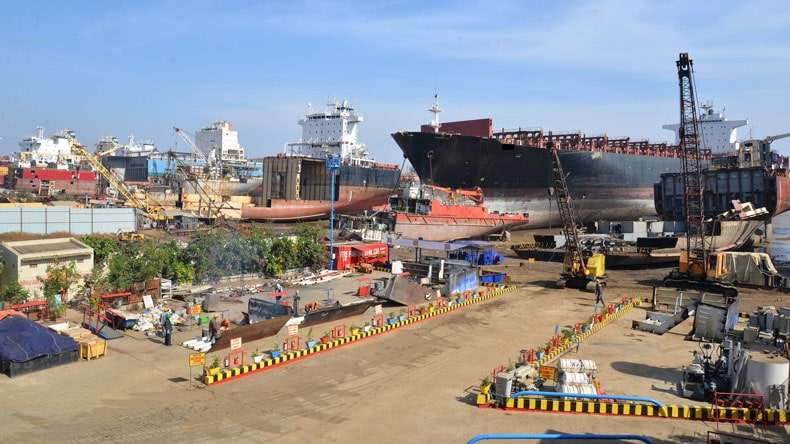
South Asian Ship Recycling Markets Under Strain as Currency Swings and Steel Weakness Grip the Sector: BEST OASIS
World’s leading cash buyers for ships sending for recycling, BEST OASIS in their weekly ship recycling market report opined that, the global ship recycling industry continues to navigate a turbulent final quarter of 2025, with South Asian markets weighed down by currency volatility, weak steel fundamentals, and an acute shortage of available tonnage. While a few isolated improvements have emerged—particularly in Pakistan and Türkiye—market sentiment across the region remains largely subdued, driven by uncertainty and cautious buying behaviour.

India: Sharp Dollar Fall Disrupts Pricing, Yards Remain Idle
In India, one of the world’s largest ship recycling hubs, market sentiment has turned highly cautious following a steep decline in the U.S. dollar over the past two weeks. The sudden currency movement has distorted price expectations between ship sellers and domestic buyers, leaving yards struggling to match offered levels with prevailing steel prices.
The rupee weakened slightly this week, slipping to 89.97 per USD from 89.46 last week—a depreciation of 0.51—adding further complexity to pricing negotiations.
Ship availability, already sparse since November, has contracted further. Most of the limited number of vessels entering the market are heading toward Bangladesh, leaving Indian recycling yards operating at minimal capacity.
Activity within the Indian market is currently driven largely by dark-fleet tankers and older tonnage trading under less transparent ownership structures. However, only a handful of yards are willing to engage in such purchases due to compliance risks, keeping overall demand tepid.
Despite the onset of seasonal winter demand—traditionally supportive for domestic steel consumption—India’s steel market continues to face downward pressure. Weak rebar prices and sluggish construction demand are curbing any meaningful price recovery, limiting buyers’ appetite for more competitive ship offers.
On the scrap front, prices for HMS 1&2 (80:20) and shredded scrap both stood at USD 358/tonne, marking a 1.56% week-on-week increase. Ship recycling prices, however, softened slightly, with container vessels quoted at USD 410/LDT, tankers at 395/LDT, and bulkers at 380/LDT, reflecting a marginal 0.25% decline week-on-week.
Bangladesh: Market Weakens Further as Steel Demand Hits Multi-Year Lows
Market conditions in Bangladesh have deteriorated further, with scrap prices sliding closer to Indian levels and local steel demand plunging to multi-year lows. A combination of reduced construction activity and the absence of major government-funded infrastructure projects has sharply curtailed consumption of finished steel, impacting recyclers’ buying power.
Currency movements added to market fragility, with the taka slipping from 122.21 to 122.46 per U.S. dollar, a depreciation of 0.25 over the week.
Even though ship prices in Chattogram remain nominally stable—HMS and shredded scrap both at USD 358/tonne and recycling prices unchanged at USD 430/LDT for containers, 420/LDT for tankers, and 385/LDT for bulkers—sentiment is largely pessimistic. Buyers are hesitant to take firm positions amid expectations that prices may fall further once current pockets of activity conclude.
Market insiders note that alignment with Indian pricing appears increasingly likely, particularly if steel mills continue to operate at reduced capacity.
Vessel arrivals remain limited, although Bangladesh secured multiple small LPG tankers this week, including the Patcharawadee 10, Patcharawadee 12, and Patcharawadee 14, all delivered to local yards at undisclosed prices.
Pakistan: Cautious Optimism as Smaller Units Spark Renewed Buying
The ship recycling market in Pakistan has shown faint but encouraging signs of recovery, supported by recent activity on smaller vessels sold at more realistic price levels. The slight strengthening of the Pakistani rupee—from 282.03 to 281.59 per USD—has also helped revive sentiment, offering buyers marginal relief from imported scrap costs.
While Pakistan still trails India and Bangladesh in price competitiveness, the renewed willingness among buyers to engage—particularly on small to mid-sized tonnage—has lifted the market’s outlook.
HMS 1&2 prices remained steady at USD 358/tonne, while shredded scrap held at USD 360/tonne, reflecting a 0.42% week-on-week increase. Ship recycling prices also stayed unchanged at USD 415/LDT for containers, 400/LDT for tankers, and 390/LDT for bulkers, with market status described as firm.
Analysts expect more units to surface at current levels, potentially stabilizing the market into early January if steel fundamentals improve.
Türkiye: Gradual Strengthening Boosts Buying Interest
Türkiye has emerged as one of the few bright spots this week, with market conditions showing gradual improvement both domestically and in scrap imports. Improvements in reinforcing steel demand and stronger Turkish lira performance—moving slightly from 42.47 to 42.50 per USD—have encouraged importers to raise their bidding levels.
Scrap prices climbed notably, with HMS 1&2 at USD 372/tonne and shredded scrap at USD 390/tonne, up 2.97%—the strongest week-on-week increase across major recycling markets.
Correspondingly, ship recycling prices rose sharply, with container vessels at USD 290/LDT, tankers at 280/LDT, and bulkers at 270/LDT, a substantial 3.70% week-on-week increase. Türkiye’s firm market stance was further reinforced by the high-profile acquisition of the Gryphon A, an FPSO unit of more than 33,000 LDT delivered to Aliaga at an undisclosed price.
Key Ship Sales of the Week
Despite weak sentiment across South Asia, several high-profile vessels were committed for recycling this week:
-
Seapeak Asia (LNG tanker, 27,450.80 LDT), sold as-is Oman at USD 420/LDT, excluding insulation, with approximately 880 tonnes of bunkers onboard.
-
Gryphon A (FPSO, 33,049 LDT), delivered to Aliaga, Türkiye, at an undisclosed price.
-
ARK Prestige (chemical/motor tanker, 3,307 LDT), sold as-is Colombo at a significantly higher price of USD 725/LDT due to its high stainless steel content.
-
Patcharawadee 10, Patcharawadee 12, and Patcharawadee 14 (LPG tankers), delivered to Bangladesh.
-
Vigo (motor tanker, 17,740 LDT), delivered to Bangladesh at an undisclosed rate.
Global Trends: Crude Prices and Exchange Rates
Oil markets remain relatively steady, with Brent and WTI crude moving only marginally during the week. In currency markets, volatility across South Asia continues to influence scrap import costs and steel pricing, creating additional challenges for recyclers already grappling with reduced tonnage supply.
Outlook: More Pressure Ahead
Across the major recycling destinations of India, Bangladesh, and Pakistan, sentiment remains cautiously negative, driven by currency pressure, sluggish steel demand, and limited vessel supply. Türkiye’s rebound offers some optimism, but global recycling volumes remain constrained overall.
Industry participants expect a challenging close to 2025, with any meaningful recovery hinging on improved steel fundamentals and greater clarity in global freight and currency markets.

Author: shipping inbox
shipping and maritime related web portal