



Prime Minister Narendra Modi’s Ro-Pax Dream on the Gulf: How Project in charge’s Greed and Corruption led to Systemic Failures which Sank the Ghogha–Dahej Ferry Project
Conceived as a flagship maritime connectivity initiative under Prime Minister Narendra Modi’s push for coastal shipping and inland waterways, the Ghogha–Dahej Ro-Pax ferry service was meant to dramatically cut travel time across the Gulf of Khambhat and showcase Gujarat as a pioneer in multimodal transport. Instead, within barely a year of its much-publicised launch, the over ₹1,000-crore project slipped into limbo — a victim of relentless Corruption in dredging, giving rise to siltation, technical miscalculations, governance lapses and what critics now describe as negligence and large-scale corruption within the Gujarat Maritime Board (GMB).

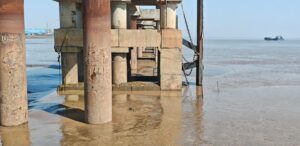
Fresh concerns have resurfaced after yet another incident at the Dahej Ro-Ro terminal, where the massive floating pontoon — measuring around 30 meters by 50 meters — was found sitting on the seabed during low tide on December 12, 2025, due to severe siltation. Maritime engineers warn that such grounding causes abnormal stresses on the pontoon’s holding arms, risking structural failure. For those familiar with the project’s troubled history, the incident was an unsettling reminder that lessons from the past remain unlearned.
A warning ignored since 2018
The Dahej pontoon grounding is not unprecedented. In fact, an almost identical incident occurred more than eight years earlier, just days before the RoRo service was originally scheduled to be inaugurated early in October 2018.
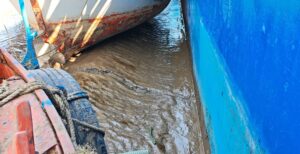
On the night of October 8, 2018, during a spring tide — when tidal ranges are at their highest — the pontoon at Dahej touched the ground at low water. One side tilted, building excessive stress on the pontoon’s holding arm, which eventually sheared off from the side shell steel. The damage forced the authorities to abruptly cancel the inauguration, which was to be performed by the then Chief Minister of Gujarat, the late Vijaybhai Rupani.
Emergency repairs required nearly 25 metric tons of additional steel and took about 18 days to complete. Only after this costly and time-consuming intervention was the Ghogha–Dahej Ro-Pax ferry finally launched on October 28, 2018.
The episode should have served as a red flag. Instead, critics argue, it was treated as a one-off mishap rather than a symptom of deeper corruption, design and planning flaws.
An unforgiving geography
The Gulf of Khambhat is one of India’s most challenging maritime environments. Known for some of the strongest tidal currents in the world, extreme tidal ranges and heavy sediment load, the gulf has long posed difficulties for navigation and port operations. Silt carried by Sea of Gulf of Khambath and rivers such as the Narmada, combined with strong tidal action, results in rapid and continuous siltation.
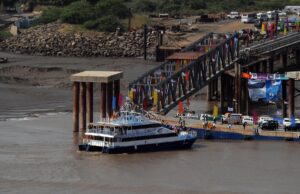
For the Ghogha–Dahej Ro-Pax service, maintaining a minimum navigable draft of around five meters was mandated to be critical for safe and reliable scheduled operations. However, ground realities proved starkly different. According to officials and operators involved at the time, the actual water depth at Dahej frequently dropped to under to two to three meters and at times about 1 meter, a depth well below the RoRo operational requirements.
The consequences were immediate and serious. Due to shallow waters Ferry operations faced repeated problems breakdowns, vessel’s machinery having trouble, engines being overheated, while manoeuvring in shallow waters and operations were delayed. Passenger confidence eroded rapidly, while operational costs mounted due to frequent disruptions and emergency interventions.
September 2019: the point of no return
By September 2019, the situation had deteriorated beyond salvage. Lack of much needed routine dredging led to heavy silt accumulation — exacerbated by discharge from the Narmada dam and gulf of kambath adverse tidal conditions — reduced the water depth at the Dahej terminal to barely one meter at low tide. This made scheduled Ro-Pax operations outright unsafe.
On September 24, 2019, ferry operations were suspended indefinitely awaiting channel dredging to maintain required safe depths for RoRo operations. The Gujarat Maritime Board invoked a force majeure clause, citing “sudden and unprecedented siltation” and openly acknowledging that maintaining the required draft at Dahej was no longer feasible with available resources.
Behind the official language, however, lay a blunt admission: the project, as conceived and executed, in absence of regular dredging was technically unsustainable.
A ₹1,000-crore question mark
The suspension effectively marked the abandonment of PM’s dream project “Ghogha–Dahej Ro-Pax project”. Despite occasional statements about revival, full-fledged operations never resumed. The reasons were manifold, a project riddled with huge corruption, wrong planning, severe environmental constraints, leading to regular dredging costs, unreliable navigation conditions and lack of financial support.
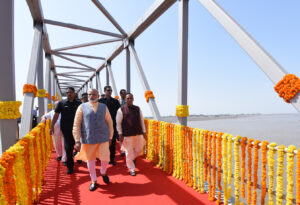
Yet, the scale of public investment involved has kept the controversy alive. With project costs exceeding ₹1,000 crore, critics question how such a capital-intensive initiative was cleared without adequately addressing known siltation risks in the Gulf of Khambhat.
Maritime experts point out that heavy and frequent continuous dredging would have been essential to sustain the project — an operational expense that could run into hundreds of crores annually. “Either the environmental realities were underestimated, or the warnings were ignored,” said a senior port consultant, requesting anonymity. “In both cases, authority’s accountability is unavoidable.”
GMB under scrutiny
The Gujarat Maritime Board, the nodal agency and the Chief Engineer who was project’s technical head and responsible for the project, now find themselves at the centre of mounting criticism. Allegations range the project being riddled in large scale corruption by the project head, poor site selection and flawed engineering assumptions to a lack of transparency in project planning and execution.
The recent grounding of RoRo pontoon at Dahej in December 2025 has further intensified scrutiny. Engineers warn that repeated grounding weakens structural components and could lead to catastrophic failure if corrective action is not taken urgently.
“This is not just about maintenance,” said a maritime engineer familiar with Ro-Pax infrastructure. “It reflects a fundamental mismatch between the terminal design and the dynamic seabed conditions at Dahej.”
A strategic pivot to Hazira
Even as the Ghogha–Dahej route struggled, authorities quietly began shifting focus to an alternative corridor — Ghogha to Hazira, near Surat, on the southern edge of the gulf. Unlike Dahej, Hazira offers comparatively deeper draft and more stable seabed conditions, making it better suited for Ro-Pax operations.
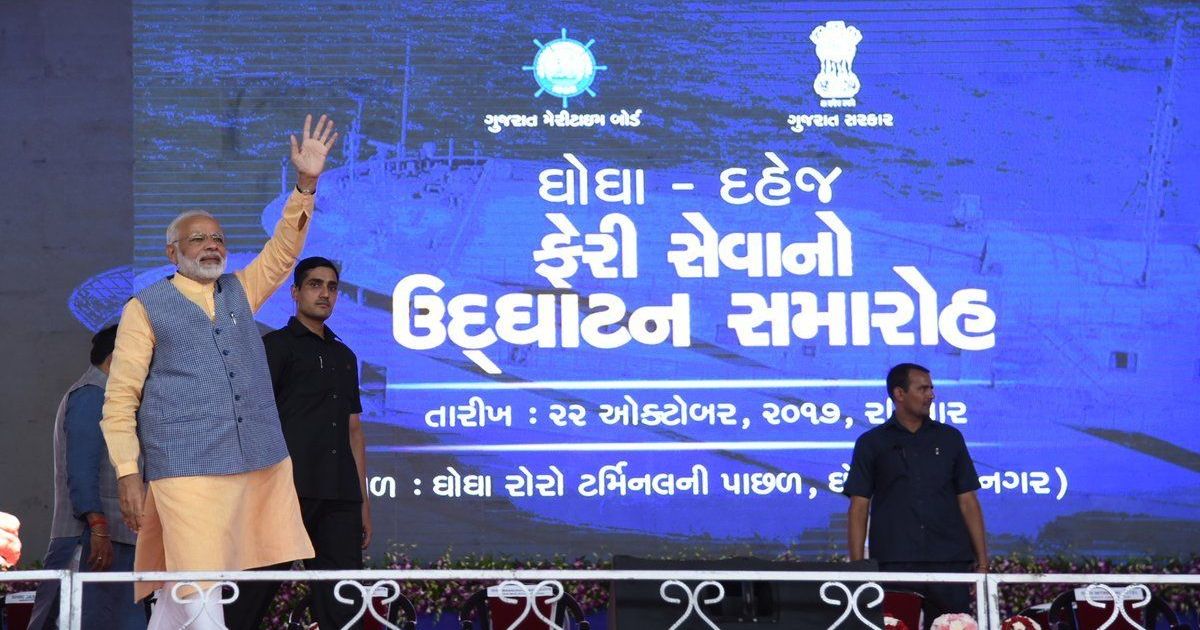
The Ghogha–Hazira Ro-Pax ferry service was officially inaugurated on November 8, 2020. Prime Minister Narendra Modi virtually inaugurated the Ro-Pax terminal at Hazira and flagged off the service via video conferencing, projecting it as a key milestone in India’s coastal connectivity programme.
Officials described the Hazira route as more technically feasible and commercially sustainable, with stronger potential demand from both passenger and freight traffic. The shift, however, also underscored an uncomfortable truth: the original Ghogha–Dahej alignment may never have been viable in the first place.
Good intent, unchecked large-scale corruption and flawed execution
There is little dispute that the Ro-Pax initiative was driven by sound policy intent. By reducing travel time across the gulf from nearly seven hours by road to about one hour by sea, the service promised economic, environmental and social benefits. It aligned seamlessly with the Centre’s broader push to decongest highways, cut fuel consumption and promote waterways as an efficient mode of transport. But good intent, critics argue, cannot excuse poor execution riddled with heavy financial corruption.
“The idea was visionary,” said a former shipping ministry official. “But vision must be matched by rigorous technical due diligence and honest assessment of risks. Somewhere between conception and execution, that discipline was lost.”
Calls for accountability
With more than ₹1,000 crore of public money at stake and Dahej infrastructure lying underutilized, calls are growing for both the Government of India and the Government of Gujarat on, Gujarat Maritime Board to identify and fix responsibility for the Ghogha–Dahej RoRo project failure.
Opposition leaders and civil society groups are demanding an independent audit of the project, including feasibility studies, dredging contracts and decision-making processes within GMB. Some have gone further, alleging gross negligence and corruption, and urging punitive action against officials found culpable.
So far, official responses have focused largely on technical challenges rather than individual accountability. While authorities have acknowledged that Ro-Pax operations at Dahej cannot resume without a viable solution to siltation, there has been no public disclosure of internal reviews or disciplinary action.
Lessons unlearnt?
The recurring pontoon grounding at Dahej in December 2025 raises an unsettling question: have the lessons of the past truly been absorbed?
For a state that prides itself on infrastructure-led development and efficient governance, the Ghogha–Dahej Ro-Pax saga stands out as a cautionary tale. It highlights the dangers of deep-rooted corruption, financial irregularities, underestimating environmental realities, overpromising outcomes and proceeding with mega-projects without robust, transparent scrutiny.
As India continues to invest heavily in maritime infrastructure under the Sagarmala programme and beyond, the failure of the Ghogha–Dahej Ro-Pax ferry should serve not merely as a footnote, but as a reminder: ambitious projects demand not just vision and funding, but also accountability, technical honesty and respect for nature’s limits.
Until those responsible for the failure of the Dahej-Ghogha RoRo project are identified and systemic shortcomings addressed, the wreckage of the Ghogha–Dahej Ro-Pax project will remain a lingering stain on an otherwise well-intentioned push to transform India’s waterways.

Author: shipping inbox
shipping and maritime related web portal